
Clear, 69° F
WORLAND — The Bureau of Land Management’s promising new partnership with the University of Wyoming and the Intermountain West Joint Venture to address the threat of cheatgrass in …
This item is available in full to subscribers.
The Powell Tribune has expanded its online content. To continue reading, you will need to either log in to your subscriber account, or purchase a subscription.
If you are a current print subscriber, you can set up a free web account by clicking here.
If you already have a web account, but need to reset it, you can do so by clicking here.
If you would like to purchase a subscription click here.
Please log in to continue |
|


WORLAND — The Bureau of Land Management’s promising new partnership with the University of Wyoming and the Intermountain West Joint Venture to address the threat of cheatgrass in northwest Wyoming saw a productive first year.
Together, the partners supported a new invasive annual grass (IAG) coordinator position to work with weed and pest districts in Big Horn, Fremont, Hot Springs, Park and Washakie counties, private landowners, Wyoming Game and Fish Department, the BLM and other agencies. According to a press release, the IAG coordinator advances a cohesive, cross-boundary strategy to tackle cheatgrass infestations on both public and private land in the Big Horn Basin.
IAG coordinator Nancy Webb and her team have covered 20,000 acres and collected over 1,000 points of vegetation data on both untreated lands and those previously treated for cheatgrass. Detailed maps and summaries of the monitoring data from those efforts are now being used by the many partnering agencies to help them in their cheatgrass management planning.
Big Horn County Weed Supervisor Cliff Winters said having Webb stationed in the Big Horn Basin has significantly benefited their operations.
“The invaluable information she’s compiled has empowered us to make well-informed decisions regarding the locations and methodologies for future treatments,” Winters said. “Nancy’s expertise and the data she has provided have proven to be indispensable assets in our ongoing efforts to manage invasive grasses.”
Monitored locations will be revisited within two years of herbicide application to understand treatment longevity and effectiveness, vegetation health and recovery, and to provide land managers with a guide for where to apply treatment if further treatment is needed.
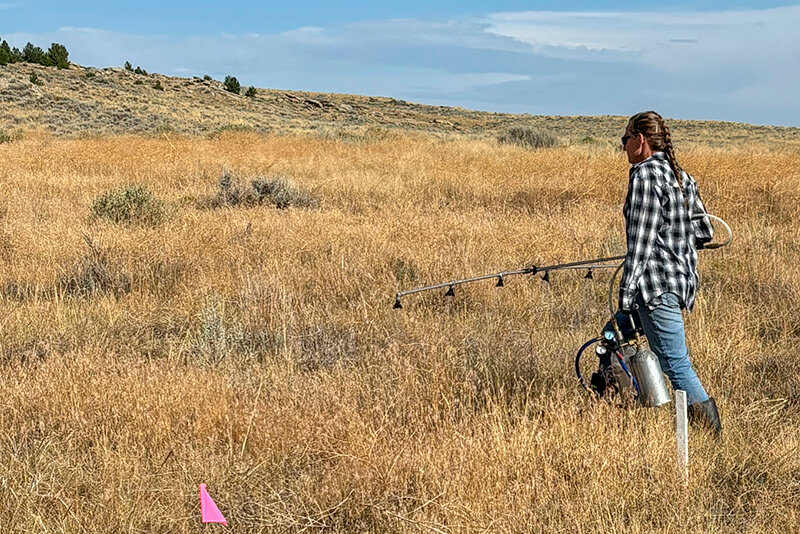
Additionally, five herbicide demonstration plots were sprayed in easy-to-reach locations in Hot Springs, Park and Washakie counties for future education and outreach purposes. Interested individuals, groups and agencies will be able to see the benefits and effectiveness of different herbicides on cheatgrass and associated native vegetation, and may begin to imagine their own future possibilities and successes in combatting cheatgrass.
“Success with invasive annual grasses is a long-term proposition,” Webb said. “Our close collaboration and shared decision making are critical to successfully manage invasive annual grasses across boundaries.”


